 Sonal Singh On Sonal's Table

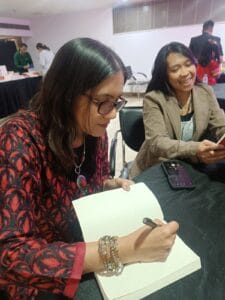
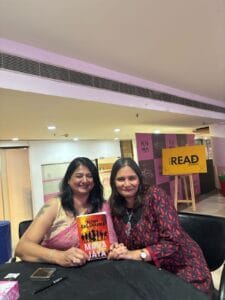
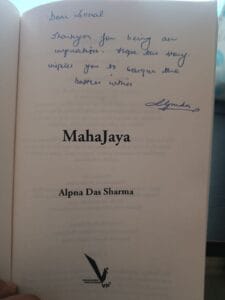
Disclaimer – Alpna is a friend, and I was lucky enough to have her author sign my copy of the book. But my friendship with her has not influenced this review in any manner.
Long back, someone told me that the Mahabharata is an interpretive scripture, simply because even though the story remains the same, each reader/listener interprets the text differently. I find one such interpretation in Alpna Das Sharma’s ‘Mahajaya’. This 244-page long paperback, published by Vishwakarma Publications, may draw a parallel from the epic Mahabharata but it’s a story of its own. The story occurs in the present, but the author uses past tense, shifting between first- and third-person narration.
The book is a socio-political drama that unfolds within the walls of a coveted Delhi college but soon spills over to encompass aspects of thrill, mystery, and suspense in a contemporary fictitious manner. Alpna has transposed the well-known Mahabharata characters into her story and is easy for the readers to infer who is who. Alpna sketched Krishna especially well as Kannan, portraying him as the sutradhar and crafty strategist.
A highlight of the book is that it’s an easy read. It is not heavy with preaching that weighs down the reading pleasure.
Things that are noteworthy in the book
1. Language – lucid and easy flowing, mostly with just a few complex words thrown in to make the reader sit up and take note. E.g., lustrum. Some paragraphs shine with Alpna’s brilliant writing style, that is her trademark. E.g., //The titian glow of wrath in Dwija’s eyes set ablaze the smouldering embers of a deep-seated regret in my being//.
2. Interpretation of the Mahabharata – this was my fav part. Using two things made this work shine for me – the college as a setting and Kabbadi as the game (an ancient game with 7 players, aptly bringing together the Pandavs, Draupadi, etc.). Alpna uses the Kabbadi contest to take the tale forward, and I found that particularly interesting.
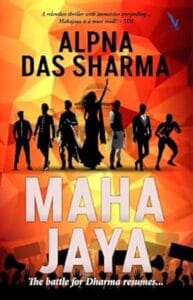
3. Cover design – it astutely captures the sangram that is to be waged within the pages and is eye-catching.
4. Characters – they are well-etched and it’s easy for the reader to draw parallels with the characters of the epic. The names given to them are apt. Dwija as the feisty Draupadi is particularly noteworthy.
5. Glossary – Alpna has thoughtfully added it, and I was grateful. So many authors forget to add a glossary.
6. The ending – this is by far the most favourite part for me. The explanation of who ‘Kannan’ was and how he influenced all those around him and in what manners. I found this part to be simply brilliant.
Things that I pondered on
1. The past tense narrative – This is something that I spent some time mulling over. Why did Alpna choose to write this story in the past tense, even though it unfolds in the present? My reasoning is that since the Mahabharata influences this book, she intentionally wrote it in the past tense to paraphrase the original epic.
2. Anshu G – This character left me wanting for more. Alpna introduces her well enough, but the veil of mystery that shrouds this character left me wanting for juicer text w.r.t her.
I would say that don’t pick this book up just because it is based on the principal idea of the Mahabharata. It is much more than just that. Pick this book up for a gripping story that melds elements of drama, mystery, suspense, thrill, intrigue, heartache and camaraderie. For the aforesaid alone, this book is a beautiful read.