 Sonal Singh On Sonal's Table

The panic that sets in the moment we step out for a journey is rarely about the journey itself. Or its uncertain outcome. It is about absence…our own.
It is about ceding control because of our absence.
We like to believe we are merely occupants of our homes (and I am not just talking about women here. It’s the entire family unit), but the truth runs deeper. We are their custodians, their silent regulators, the unseen system that keeps everything in balance, in check, and running smoothly. Every switch turned off, every latch secured, every appliance checked, every plant watered…these are not just actions. They are rituals of control. Small assurances that the world we leave behind will not spin out of existence. That it will remain exactly as we left it.
And then we leave.
The door shuts. The lock clicks. Finality!
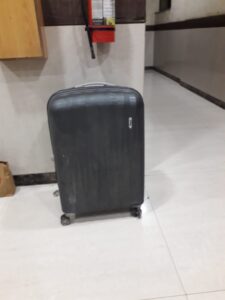
And suddenly, with one hand firmly pushing the suitcase forward, control becomes theoretical.
The mind, deprived of direct verification, begins to compensate. It replays, reconstructs, and interrogates.
Did I turn off the gas?
Are the windows latched? Especially the master-bedroom window, where the pigeon nests on the ledge?
Did I turn off the AC mains?
Did I leave dishes in the kitchen basin? Oh, no. They’ll catch fungus.
Are the plants watered enough? Maybe I should just add some more water to the creeper.
Suddenly, as our steps move towards the waiting cab, every question becomes more than a question. It becomes a test of memory. Each doubt is not random; it is precise, targeted, and deeply logical in its own way, jabbing at our panic button…repeatedly. It is just the brain doing what it does best, what it is designed for…anticipating risk in the absence of certainty.
‘This is not irrational panic. It is misfired vigilance,’ it says.
At home, within reach, certainty is sensory. You see the knob turned off. You hear the click of the latch. You feel the switch turn in the right direction under your fingers. Outside, all of that collapses into memory. And memory, no matter how reliable, is not as convincing as presence. So, the mind escalates. It fills in gaps with possibility. And possibility, when left unchecked, almost always tilts toward worst-case scenarios.
But beneath the surface logic lies something quieter, more human.
Control, for most of us, especially women and homemakers, is not about power.
It is about responsibility.
Our homes are extensions of our identity, of our care, our service, and our love. To leave them unattended feels, at some level, like neglect. The questions that chase us are not just about appliances; they are about accountability. Have I done enough? Have I left things safely? Have I fulfilled my role?
And because there is no immediate way to answer these questions, the mind loops.
What makes this experience universal is not forgetfulness, but attachment. The more invested we are in a space (like home), the harder it is to relinquish control over it. The panic is, strangely, a measure of how much we care.
The only real resolution lies not in checking things again and again, but in understanding the mechanism itself. The mind seeks certainty. When it cannot find it, it manufactures urgency. Recognizing this doesn’t eliminate the questions. But it changes how we respond to them.
Instead of chasing each doubt, we can acknowledge it for what it is—a deep, protective instinct overshooting its mark.
Because the truth is, long before the questions begin, the actions have already been completed. The gas has been turned off. The windows have been latched. The geyser is off. So are the ACs. The plants are watered. In short, the house is as secure as it was meant to be.

What lingers is not risk, but the echo of responsibility, struggling to let go.
Have you ever experienced something like this?